August 2026 Open Forum Discussion

Hopefully I will get time to post a topic list this weekend!

Welcome to Christogenea.
Why did ancient Egypt, once the greatest of all nations, crumble into oblivion, where it has remained for 3,000 years? What happened to the glory of ancient Babylonia, or to Assyria? Where is the splendour of the ancient Persians, or the Medes, or Parthia? How have the Greeks, the pinnacle of ancient civilization, not produced anything of note as a culture since the fall of Byzantium nearly 600 years ago? What happened to the might and the majesty that was Rome, once far greater than them all? How, or why, have all of these once magnificent cultures for so long been little more than quarries for museum relics? America, and all of Christian Civilization, is now following in the footsteps of these ancient empires. It's absolutely true. The evidence is all around you. History does indeed repeat itself, again and again because people refuse to learn from it. But there is a solution.
You can deny it. You can rant and rave. You can scream. You can cry "hate" and utter blasphemies. You can make railing accusations. But you can't change the truth. A shining city on a hill cannot be hid. A lamp when lit is not placed under a couch. There is indeed a God of all creation. And there is indeed a race anointed by that God. Here it is identified. Whenever that race allows itself to amalgamate with others, it falls into permanent decay. Understanding this is one of the keys to all history, and it is the understanding of the rise and fall of all great cultures. You can go away mad, even spouting profanities, or you can face the reality, and consider the implications while investigating the assertions being made. For more information, START HERE.
Hopefully I will get time to post a topic list this weekend!
Highlights in Exodus: The Confrontation
In Exodus chapter 3, Moses had received his appointment from the “angel” in the burning bush. Notice that while the apparition of burning in the bush was called “the angel of Yahweh” in verse 2 of the chapter, Yahweh Himself is characterized as having done all of the speaking. This should broaden our concept of the use of the word angel. The corresponding Hebrew and Greek words simply mean messenger. While an angel may be a man, and it may be a supernatural entity or being, it may also be anything which Yahweh God wants to utilize in order to send a message to men. So the burning in the bush was an angel, insofar as it was a physical apparition by which Yahweh had gotten the attention of Moses, so that He may speak to him. Since Yahweh God Himself is invisible to men, basically any physical apparition representing His presence is an angel, such as the pillars of smoke and fire which shall be manifest later in this Exodus account. This changes with the advent of Yahshua Christ, whom Paul of Tarsus had described as the image of the person of Yahweh in the opening verses of his epistle to the Hebrews.
With that event at the burning bush, we also learned from the ensuing dialogue why it is that Moses had called Him Yahweh, since when he asked God what He should be called, he was told, in verse 14 of that chapter, that “I AM THAT I AM: and he said, Thus shalt thou say unto the children of Israel, I AM hath sent me unto you.” Here we explained that the phrase which translates as “I AM” is אהוה or ahavah, which is the Hebrew word הוה or havah (# 1961), a verb which means to be, prefixed with the letter א or aleph, so that it becomes a first person verb meaning I am. So Moses, from his own perspective, understood the Name given by God to mean He is, and in proper Hebrew grammar the aleph is replaced with a י or iota, by which the verb is converted to the third person and the spelling is יהוה, which may be pronounced Yahweh or perhaps Yahavah. While we shall never really know how the verbs were enunciated in ancient Hebrew, the oldest testimony is that of Flavius Josephus, who had said in Book 5 (5:235) of his Wars of the Judaeans that the Name of God “consists of four vowels”. Since Josephus was writing in Greek, he must have meant four Greek vowels, and we can pronounce the name Yahweh with four Greek vowels, but that does not work for Yahavah.
This evening I appeared for one hour with Etta Volk of Critical Review. The conversation was mostly about the racial aspects of Scripture. Click here for the program page. Click here for the file download. Use the player below to listen.
It’ll Be More Blessed to Be “Left Behind”! A Review of a Paper by Clifton Emahiser
The past few weeks have been difficult, and I had been compelled to miss a few podcasts, which I really hate having to do. Aside from some health issues I have had to address, for which I should be limiting the time I spend sitting at my desk, on the afternoon of Wednesday July 29th the computer I had used every day for the last eight and a half years needed to be rebooted, and it never came back on. Once I get the time, I am sure I can fix it, but in the meantime it was a lot quicker to replace.
Then on Wednesday August 7th, not long after 5:00 PM, the main Christogenea website suddenly went offline. The server was the victim of a purposeful hacking, and while a couple of things are going to remain unexplained, an exploit had been published for some of the software used by the server, and that exploit allowed a hacker a way into the system. The hacking was perpetrated through a sophisticated set of scripts, and while the target might have been random, which is less likely, to get past the firewall the hackers must have significant internet resources. But it is easier to move on and rebuild than to sit around and cry about what had been done, so by Friday afternoon Christogenea was back up and running on a new and better server. Doing that, I also took many additional precautions with the hope of making another hacking attempt even far less likely.
So this week I have decided to offer some lighter fare, and present and critique a paper by Clifton Emahiser, the title of which is a stab at a popular book series which had been published for a decade beginning in the late 1990’s, and generally titled Left Behind. The book series capitalized on the evangelical belief in a so-called rapture, a heresy which was evidently developed by John Darby, and later popularized by the Scofield Reference Bible, as well as books such as the Left Behind series. So here in the American South we often see these corny rapture bumper stickers, stating things such as “Warning in Case of Rapture This Car Will Be Unmanned” or “Your Choice: Rapture Ready or Left Behind”, among a hundred other childish and pretentious sentences.
Help our friends launch a new Youtube channel! Subscribe - View Channel - See Video - Part 1 - Part 2
Highlights in Exodus: The Appointment
In our last presentation in Exodus, titled The Life, and Wife, of Moses, we had also taken some time discussing the Tel el Amarna tablets, which contain a cache of correspondence from the various rulers of the city-states of Canaan, most of them written to the Egyptian Pharaoh Akhenaton. This was expedient to do, since in our first presentation, The Exodus In Controversy and History, we discussed inscriptions left behind by his immediate predecessor, Amenhotep III, which mentioned a people whom he had described as the “nomads of Yahweh”, and as having been in the land of Canaan in his time.
We have dated the Exodus event to about 1450 BC. Amenhotep III ruled Egypt from about 1391 to 1353 BC, and Akhenaten from about 1353 to 1336 BC, according to the general chronologies which sometimes differ by a few years. So after forty years of wandering in the desert of Sinai, the children of Israel, the only group who could possibly have been called the “nomads of Yahweh”, are in Canaan, which is consistent with the Biblical account of the book of Joshua. Then some time later the rulers of the various cities in Canaan are appealing to help from Egypt to ward off the invading hapiru, or habiru, a group which academic scholars are resistant to identifying as Hebrews, in spite of the consistency of the reports in the Amarna tablets with the events recorded in the books of Joshua and the early chapters of Judges.
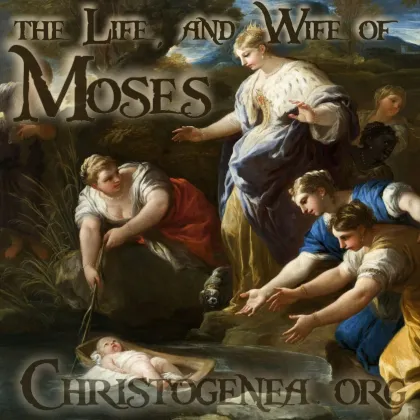
Highlights in Exodus: The Life, and Wife, of Moses
In our last discussion of Exodus, titled The Exodus In Controversy and History, we illustrated how the children of Israel in their nomadic post-Exodus period were described as the “Shasu of Yahweh”, which is to say, “Nomads of Yahweh”, by pharaoh Amenhotep III in inscriptions which had been made some time around 1390 BC. This correlates very well with our general estimations of the time of the event of the Exodus from 1450 BC. After over forty years of wandering in the Sinai desert, an event which the Egyptians must have spied out somewhat regularly, even if the children of Israel had gone north to the plains of Moab, and began to invade Canaan at that time, Amenhotep III must have known of their presence wandering in the wilderness, and recorded it as he had known it. This, beyond all doubt, proves the general veracity of the Exodus account.
The memory among the nobility of the Name Yahweh, a Name with which Moses had confronted the pharaoh in subsequent chapters of Exodus, also serves to corroborate the Exodus account of the plagues of Egypt and the ultimate release of Israel. So those events must have been sufficiently notable that the house of the pharaoh remember the Name of Yahweh.
Now here I am going to take an opportunity to take this proof of the historicity of the Exodus account a step further in Egyptian archaeology. While there is much academic debate as to whether the habiru or hapiru of the Tel el Amarna tablets are the Hebrews of Scripture, I would certainly insist that they are. But academic scholars point to the apparent use of the similar Akkadian word hapiru to describe groups of outlaws, brigands or robbers, or also marginalized outsiders or refugees. With this I disagree.
My first contention is this: a marginalized ethnic group taken to living outside of the fringes of society may naturally be perceived in such a manner, and the Hebrews, whether in Egypt or in Padanaram, do seem to have been marginalized and disenfranchised, having had no distinct land of their own. Then we should consider colloquialisms. For example, in Medieval Europe the word Slav, describing the people of Eastern Europe, became synonymous with slave in English, as the Vikings regularly traded Slavs as slaves in the West, whereby we have our word slave. In America today, if someone, even a friend, burdens you with undue requests, you may look at him and say something like “What am I, your nigger?” Of course, you are not making a statement that you are black, but blacks had been slaves for several hundred years, and they are the most recent slaves in our historical experience, so blacks are still associated with slavery in parts of our vernacular. The Israelites having escaped Egypt may easily have been seen in that same manner.

Bald Clone thought he might make it Wednesday, but couldn't. So HoTpOck and I just had a talk about life.
Highlights in Exodus: The Exodus In Controversy and History
Here I am going to endeavor a discussion of the Book of Exodus. This will not be a verse-by-verse commentary. Rather, I will focus on the historical details of the Exodus, on an outline of the history of the children of Israel in the Book of Exodus, and also on the Law, as Christians are often confused concerning the Law, in reference to which commandments are those that Christ expects His disciples to keep, and which commandments are the rituals and civic laws of Israel which are now obsolete under the New Covenant. I may interject comments on other passages where it is fitting. As we always have done in our Old Testament commentaries, we shall follow the King James Version, and do our best to note the significant differences which may be found in the Septuagint, the Dead Sea Scrolls and even the early translations found in the Hexapla of Origen.
On the history of the Exodus, most Christians who pay attention to the mainstream academic jargon, especially when it is echoed in popular media, should already be aware that this is always under attack by one academic scholar or another, and there are always fascinating new “discoveries” which seek to discredit the Exodus account. However sometimes there are discoveries which demonstrate its historicity, and hopefully we shall discuss the more significant of those here.
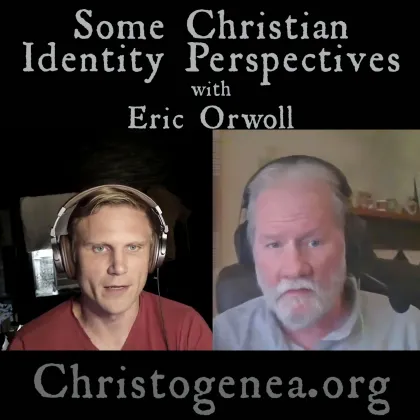
Eric Orwall is founder of the Return to the Land community in northern Arkansas.
For a more comprehensive answer to my objections of DNA studies to determine Whiteness and population movements, see the July 3rd Topical Discussions podcast titled Muddy Theories.
For a better answer to my objections to the existence of the Hyperborea described by Aristeas see this Christogenea Forum topic: Herodotus and Strabo Cast Doubt on the Hyperborea Story of Aristeas (I had actually forgotten which writer had called Aristeas a "charlatan" so I did not go there during the podcast.)
To watch the video rather than listening, CLICK HERE.
July, 2026 Topical Discussions: Muddy Theories
Tonight we shall discuss the folly of “Tartaria” and other chronology gimmicks, and also the folly of building a Nationalist worldview based on DNA “Science!” which denies the existence of race as a biological entity.
Establishing the truth behind our general perceptions of historical chronology: the folly of “Tartaria” and other chronology gimmicks.
Some of this evidence, I had discussed in a recent podcast on 88streams.com, but I wanted to present a more complete version of the evidence against the so-called Tartaria theory.
There are conspiracy theories of some ancient, advanced kingdom called Tartaria, which often include sub-conspiracies claiming that centuries had somehow been added to the calendar, centuries which never actually existed in some grand conspiracy to make antiquity seem even more remote. The proponents of these theories take advantage of the historical ignorance of their listeners, and are even ignorant themselves. Some claims even assert that the “Tartarian Empire” was global, that even buildings in America are the products of a bygone civilization which somehow disappeared in “mud floods” and natural disasters. All of these claims are patently absurd, and absolutely false.
The older European maps labelled most of the interior of Asia as “Tartary” only because Europeans were familiar with the people called Tatars who had entered Russia from the East in the Middle Ages. But the entire land east of Russia was unexplored, so they used that name to describe the entire unexplored region. This practice was evidently begun when the label Tartary first appeared on a map by a Venetian cartographer Giovanni Contarini in 1506, and then by Dutch explorer and cartographer Johannes Ruysch in 1507. The British and others continued the practice of labelling the quite vast but unexplored land as Tartary. But Magellan’s famous expedition circumnavigating the earth did not begin until 1519, Magellan himself died in 1521, and it was completed without him in 1522. But Russia did not conquer Siberia until the 17th century, and the rest of its territories in Asia until the 18th and 19th centuries.
The most pressing issues of the day: Replacement migration, the Camp of the Saints and Who is your God?
The presence of Hindus in rural Indiana, and the rural South.
The state of Christianity in Europe, especially Germany and Britain. Scottish churches being turned into kebab shacks!
Sven Longshanks visited the All Saints Church in Hereford, England to see the lewd carving posted in a photograph at the Christogenea Forum, other sites recently visited by Sven and members of Patriotic Alternative.
The state of the “Far Right” and “Christian Nationalism” in Social Media: in the hands of non-Whites, fornicators and Sodomites.
Sven on Rupert Lowe and Nigel Farage, British politics and prospects. The crisis in Northern Ireland over the recent attempted beheading and resulting riots, the IRA and Sinn Fein is explicitly anti-racist and in opposition to the riots.
The Social Media phenomenon gives people a false feeling of accomplishment versus actually doing something in real life.
Home Bible studies and seeking for friends and acquaintances to join them as a way to evangelize Christian Identity and an alternative to churches.
Number of jews in America is probably 90% underestimated.
Russia today and prospects of Ukraine War escalation to include Germany or Western Europe.
Augustine, Plato, and the proper Christian attitude towards jews.
The Opium Wars, Jewish bankers, and English and US military involvement on their behalf.
The origins of Hebrew language, Hittites, Hurrians
And more! Thanks to all those who participated!
Paul Fromm has been an advocate for free speech in Canada for many years. Somewhere I have a video posted of a David Irving speech at the University of Toronto where he had introduced Irving, and I think that was in 1992. Paul had assisted the defense in the Canadian trial of Ernst Zündel in the late 1980's, and he was also involved in the Terry Tremaine case in 2006.
The Canadian Charter of Rights and Freedoms is in the Constitution Act of 1982.
The Combatting Hate Act which "received Royal Assent on June 18, 2026."
A Commentary on Isaiah, Part 71: The Appointed Place
In Isaiah chapter 64 the prophet had presented A Prayer for Repentance, where he had portrayed the children of Israel as having prayed to Yahweh their God for mercy, and also that He would take vengeance upon His enemies, since for Israel it is evident that there is Mercy in Vengeance, as we had seen in our discussion of Isaiah chapter 63. Then in Isaiah chapter 65, which we had titled Christians and Pagans, we see that the prophet had recorded the answer of Yahweh to that prayer, and while most of it was directed towards the obedient of His people, those who would choose to serve Him, for their good, there were also grave warnings for those who would remain rebellious, that they would be put to the sword. As they were described in that chapter, we could only describe the obedient as Christians, who would wait on Yahweh for their salvation and hearken to His Word, and the rebels as pagans, as they continued in their licentiousness and their sin. So with this is a valid explanation for the wars of the children of Israel as they migrated and settled into their new homes in the Appointed Place, which is described in the closing verses of this final chapter.
Subsequently, for the obedient there was a promise of a New Heavens and Earth, and the answer to their prayer continues through Isaiah chapter 66, and the very end of this book of prophecy. Where we had left off with verse 4 of this 66th and final chapter of Isaiah, the Word of Yahweh had once again turned to the contrasting fates of Christians and pagans, of those who would obey Him and those who would not, where He had had avowed to consider the humble and contrite, those who respected His Word, but for those who would not, He said:
4 I also will choose their delusions, and will bring their fears upon them; because when I called, none did answer; when I spake, they did not hear: but they did evil before mine eyes, and chose that in which I delighted not.
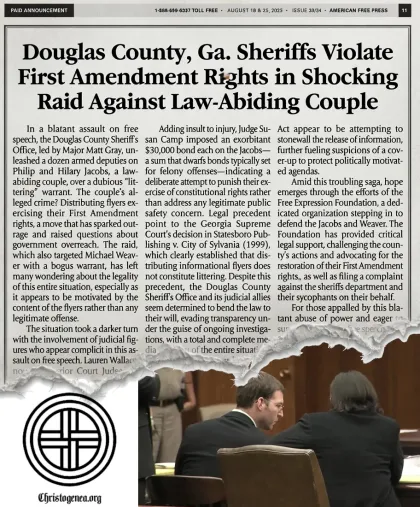
Michael Weaver has been fighting a battle over free speech and legal literature distribution for several years now. This battle has included some ridiculously oppressive acts on the part of Georgia law-enforcement, such as raids on the home of Philip and Hilary Jacobs for a littering charge, something which I have never heard of in my entire life. Imagine a $30,000 bond for littering. A prosecutor in the case even doxxed Philip’s pamphlet distribution activity to his employer, getting him fired. So with prosecutors like that, there is no need for Antifa activists. It does seem like they are taking marching orders directly from the ADL.
Articles of Interest:
When Tyranny Becomes Law --- When Tyranny Doubles Down --- When Tyranny Persists --- Free Speech Under Attack in Georgia
Donate to the cause: Michael Weaver's defense fund
Littering Statute in Georgia
O.C.G.A. §16-7-42(a) defines littering as any discarded or abandoned refuse, rubbish, junk, or other waste material, or dead animals.
From the Free Expression Foundation's Update on Pending Litigation:
Jacobs, et al. v. Catlin, et al. U.S. District Court for the Northern District of Georgia....
 So far this year, Christogenea has operated with a deficit equivalent to nearly a month's worth of our expenses. Our cash reserves are nearly exhausted. Under such circumstances we cannot continue for long, as we have approximately $1500 monthly online hosting expenses alone.
If you appreciate our work, please remember that it is not "free" to produce or to keep freely available. Please help support Christogenea and keep us working!
Support Christogenea via GiveSendGo! Christogenea is 100% reader supported. If you find value in our work, please contribute and help to keep it going! See our Contact Page for more information.
Aside from over 15 separate websites, a chat and 6 radio streams, Christogenea freely hosts over two dozen unrelated Christian Identity or Christian Nationalist websites, and William Finck spends at least 60 hours a week, usually longer, managing the technical aspects of this endeavor, and producing new content.
Should Christians really embrace Jews, after seeing what Jews have said for many centuries about Jesus? Why don't Christians at least listen to what Jesus had said about Jews?
See this and more at https://truthnuke.media/

Check out our friends at https://88streams.com/

The Megiddo Mosaic was discovered under the floor of an Israeli prison in Megiddo, in 2005.
Currently, Christogenea has several categories of podcast feeds, which are found at the following URLs. The feed for all podcasts is quite long, and does not always update properly. Sometimes I get timeouts, as there are about 1300 podcasts:
https:/christogenea.org/podcasts/mp3feed
This is a feed for the newest 60 podcasts, which is expected to be more efficient:
 A friend has created a Christian Identity: Handbook Against Heresies which seeks to compile and explain from Scripture a collection of basic Christian concepts which is meant to be a quick witness to help address and combat basic heresies and misunderstandings. This may also serve as a good primer for those wanting an overview of our general Christian Identity professions.
The Handbook was updated and a new copy posted July 5th, 2024. We expect this to happen periodically.
Download the PDF handbook here. There is also a clean version formatted for printing without any underlined cross-references and no highlighting. Another version without highlighting removes all background color from the text, but it has underlined cross-references. here you may also download the clean version, the version without highlighting, or now for a combined version which contains both highlighted and clean copies of the text.
A scorpion and a frog meet on the bank of a stream and the scorpion asks the frog to carry him across on its back. The frog asks, "How do I know you won't sting me?" The scorpion says, "Because if I do, I will die too."
The frog is satisfied, and they set out, but in midstream, the scorpion stings the frog. The frog feels the onset of paralysis and starts to sink, knowing they both will drown, but has just enough time to gasp "Why?"
Replies the scorpion: "Its my nature..."
Never expect anyone to act contrary to their nature.

A completely new translation by William Finck of Christogenea.org, based on the text of the Rahlfs-Hanhart Septuaginta, but not necessarily following the punctuation of that edition. Download the PDF here. There is also a navigable chapter-by-chapter Greek-English Interlinear Version.
The Wisdom of Solomon is a profound and inspired work of literature, which, with all certainty, should have been included in the canonical Scriptures alongside the other works of Solomon, regardless of the fact that there is no extant Hebrew manuscript. The work is found in early lists of church canon, such as the Muratorian Canon, and it was included alongside the other Biblical books of wisdom in the Old Testament in the 4th century Codices Sinaiticus (א) and Vaticanus (B) and in the 5th century Codex Alexandrinus (A). While there have been contrary claims, for example at the Israeli website deadseascrolls.org, no supporting evidence has been presented, and therefore the work has evidently not been found among the Dead Sea Scrolls. However we must wonder if those examining the Scrolls would even recognize it, since there is no known Hebrew text against which to reference any possible fragments.
Here we have several images from the Junior Classic Latin Dictionary. In his later papers, after he had found this definition, Clifton Emahiser cited this lexicon in relation to the meaning of the Latin word gentilis, which is "of the same clan or race", and how that true meaning of the word may affect one's view of Scripture, since with that meaning the truth of the nature of the covenants of God is revealed.
The word gentilis is the Latin word that Jerome had employed to represent the Greek word ἔθνος, or nation, in his Latin Vulgate, and that is the underlying word where the King James Version has gentile or gentiles in the New Testament. Jerome may have used any one of several other more general Latin words which may mean nation, but he purposely selected this more specific term.
The word gentilis never meant "non-Jew" to any Roman!

Christian Identity: What Difference Does it Make?
It is no mistake that 2000 years ago, Christianity spread and was accepted by tribes of White Europeans as they encountered it. It is no mistake that for the last 1500 years Europe has been predominantly Christian. Christianity had spread not only to both Greece and Rome, but also to Britain and other points in Europe as early as the middle of the first century. Tribes in Gaul were converting to Christianity in the second century. By the third century, if not sooner, Germanic tribes of the Goths and Alans had accepted Christianity. All of this was long before the official acceptance of Christianity began with Constantine the Great, the Edict of Toleration and the Council of Nicaea.
To mock Christianity today is to mock a hundred generations of our ancestors. People who mock Christianity think they know something better about our past than their own ancestors, the people who actually lived in those times many centuries ago. The truth is that the people who mock Christianity know little-to-nothing about the world of the past and the circumstances under which their ancestors ultimately accepted Christianity.
There are many incongruities in the perception of the people who mock Christianity today. On one hand they claim that it is a “cuck” religion, and on the other they complain that their ancestors were forced into Christianity by Christians. So they admit that their own ancestors were weaker than the “cucks” they despise. On one hand they claim that Christianity is an effeminate religion, and a Jewish religion, but then they complain that their ancestors were forced into it by Christians. So they admit that their ancestors were weaker than effeminates and Jews. All the while, they proclaim the “might is right” mantra of their own neo-paganism, while professing that their weak ancestors, forced to subject to Christianity, were somehow treated unfairly! Those who mock Christianity are simply too stupid to realize all of these cognitive disconnects, and there are many more that we won’t get into here. We already presented them here a few years ago, in two podcasts titled White Nationalist Cognitive Dissonance.
The alien hordes currently pouring into Europe, and also into America and other White nations, are fulfilling Biblical prophesies made many centuries ago. The proof is in a history which few now know, because Classical literature is irrelevant to modern churchmen, and the Bible is alien to classicists. Interpretations of archaeological discovery are seen through a Jewish worldview, and that worldview is also based on falsehoods. But when we come to love the truth of our God, we can no longer be blinded by the satanic Jews.
There is No Political Solution - A 2015 podcast based on two separate essays, There is No Political Solution and Who is your god?, both written in 2009.
The Parable of the Trees of the Forest, is a segment from a February, 2012 open forum podcast, which helps explain why all of our popular political leaders and influencers are pure scum, the brambles of the parable found in Judges chapter 9.
The Immigration Problem and Biblical Prophecy - 2011-11-05
No Safe Haven: Stripped Bare and Naked - 2013-08-16
"If my people, which are called by my name, shall humble themselves, and pray, and seek my face, and turn from their wicked ways; then will I hear from heaven, and will forgive their sin, and will heal their land." - 2 Chronicles 7:14
Click HERE listen to our streams.
There is now a completely new schedule with different programs for each stream every day. Click here for Radio info. Last update: September 17th, 2024
Click here for Radio Albion.
William Finck on the Delingpod June 28th, 2025 (Sorry, currently subscriber-only).
Are the Jews God’s ‘Chosen’ People? - William Finck with Jerm Warfare at UKColumn May 28th, 2025
 The audio archive for the MEIN KAMPF PROJECT at Christogenea.org houses many programs related to the history of the 19th and 20th centuries which are not found here at the main Christogenea website.
 The Christogenea archive site contains older material produced at Christogenea and elsewhere that has been retired from our main website but which we certainly feel should remain available.
Christogenea is reader supported. This month's support level is reflected in the graph below. See our Contact page for a mailing address and other ways to support Christogenea.
100 %






Commentaries and Podcasts